Politics
Evening Pulse: INDIA bloc rallies in Delhi for election chief’s resignation
The November 1 mobilisation takes place; rival claims about democracy require documentary scrutiny.
Pan India Pulse deskBased on reports from The Hindu, The Indian Express, Free Press Journalहिन्दी में पढ़ें
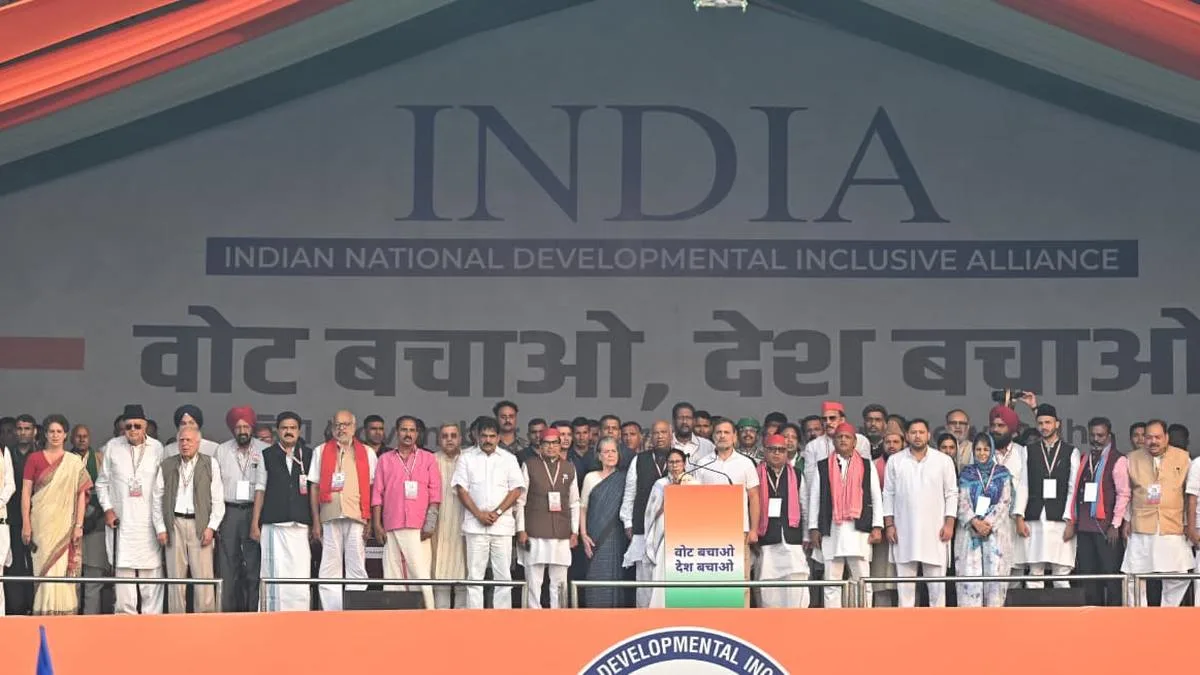
Opposition INDIA bloc leaders addressed a rally at Delhi’s Ramlila Maidan on Sunday, November 1, demanding Chief Election Commissioner Gyanesh Kumar’s resignation over alleged electoral irregularities. The Hindu and The Indian Express report the gathering and speeches by leaders including Rahul Gandhi, Mallikarjun Kharge, Mamata Banerjee and Akhilesh Yadav. Their presence establishes a shared protest platform; the allegations made from it remain allegations.
The rally closes an immediate loop in the previous Pulse. The symbolic proceedings postponed by rain took place on October 31, according to The Hindu’s subsequent account, and were followed by Sunday’s public mobilisation. Organisers described Saturday’s event as public impeachment. That political description should not be confused with a completed constitutional removal process or a judicial finding against the election chief.
The Indian Express reports that Sunday’s march began at the Minto Road–Connaught Place junction and proceeded towards Ramlila Maidan. Party supporters and youth and student wings joined the programme. The paper records Kharge’s pledge to continue the campaign until Kumar leaves office. Neither the gathering nor the determination of the speakers establishes the truth of an individual voter-list complaint.
The opposition’s case centres on the Special Intensive Revision of electoral rolls and its allegations of vote theft. Rahul Gandhi renewed accusations against the Prime Minister; other speakers connected the issue to their own states. This Pulse does not adopt the numerical deletion claims or allegations of conspiracy repeated at the rally. Establishing an unlawful deletion requires the relevant roll, the reason recorded for removal and the correction or appeal record.
The BJP’s response was visible on Sunday. In Thane, Chief Minister Devendra Fadnavis and Deputy Chief Minister Eknath Shinde appeared together at a Loktantra Bachao rally. Independent accounts in The Indian Express and Free Press Journal describe their attacks on Congress and its allies. Their claims that the opposition is undermining institutions or promoting disorder are political accusations, not findings that peaceful protest itself is unlawful.
The two developments dominating the reviewed multi-outlet coverage are the election-administration mobilisation and Andhra Pradesh’s municipal polling. They concern different institutions and procedures. The Delhi campaign challenges election administration nationally; Andhra’s disputes concern particular polling stations, reported incidents and possible repolls. A shared vocabulary about democracy does not make evidence from one dispute proof of another.
The Indian Express’s account of the earlier police permission provides another useful distinction. The organisers had sought a no-objection certificate for the designated venue, and police described coordination with organisers and traffic authorities. Permission for a programme is an administrative fact, not official endorsement of its speeches. The October 31 proceedings and November 1 rally should therefore be assessed through what was presented and what response it received, rather than through the mere existence of permission. Attendance by several party leaders is observable cooperation on this issue; a common position on every future state election is a different proposition.
For readers, the useful next development is a document or decision that resolves a specific complaint. The Delhi rally has happened, so it no longer belongs on a future-events list. Attention shifts to published exhibits, a substantive Election Commission response and the next announced legal or political step. No election outcome can be inferred from Sunday’s stage or the competing rallies.
Political Alignment Lens
Article framing only. This does not establish publisher affiliation, reader beliefs or voting intent.
Pulse view
Analysis by the Pulse deskStrategies and tactics: the evidence. The movement from October 31’s symbolic proceedings to November 1’s mass gathering supports an interpretation of escalation through different public formats. The mechanism is agenda-setting: keep the election-administration dispute visible while combining parties with different state interests. The dated sequence is documented; hidden coordination or deceptive intent is not.
A serious alternative is ordinary joint protest after a rain-disrupted schedule, rather than a durable common campaign. Separate party programmes, withdrawal from shared demands or a shift to resolving individual roll cases would weaken the escalation interpretation. The counter-rallies offer a competing institutional narrative, but timing alone establishes no covert coordination. Which specific voter-list record should be made public first so citizens can assess the dispute themselves?
Strategies and tactics: the evidence
Our signature analysis has its own dedicated page, with the event sequence, source evidence, alternatives and historical comparisons.
Read the full strategy analysisWhat to watch
- Publication of case-specific exhibits from the opposition proceedings.
- Election Commission replies to identified voter-list complaints.
- Any announced court filing or next protest programme.
Your take
Do you agree with the Pulse view?
Sources
- November 1 rally and October 31 proceedings The Hindu
- Leaders address Ramlila Maidan rally The Indian Express
- Fadnavis and Shinde at Thane rally The Indian Express
- Thane speeches Free Press Journal
This piece is analysis written only from the published reports listed above. Pan India Pulse does no original reporting. How this site works